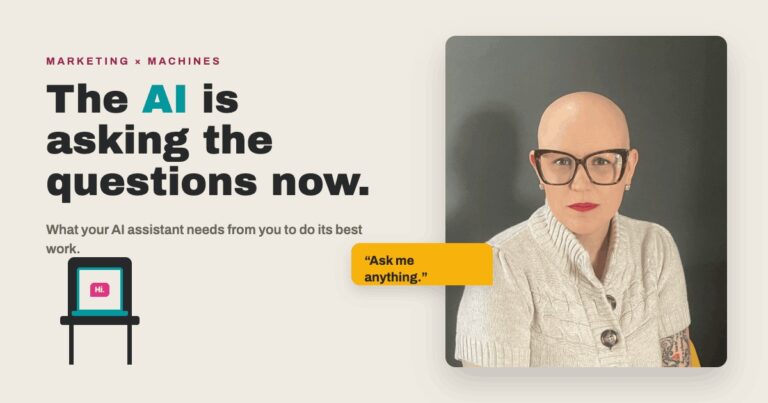
Let’s be honest: most of us still treat AI like a genie in a bottle never stopping to ask what AI needs from you. “Here’s my vague prompt — make magic happen!” But here’s the twist — AI isn’t magic. It’s a very capable, very literal collaborator that thrives on clarity, structure, and context. And in 2026, it’s not just waiting for better prompts. It’s waiting for you to stop starting from scratch every single time.
Because here’s what changed: tools like Claude now have persistent memory, project workspaces, and direct connections to your actual business tools — your CRM, your calendar, your files. The AI conversation stopped being a one-night stand and became a working relationship. So the question isn’t “how do I write a better prompt?” anymore. It’s about knowing what AI needs from you to do real work.
And before you question my sources: I went straight to the source. I opened Claude and asked it, point blank, “What do you need from us?” This entire post is the answer. You’re reading AI’s own wish list, transcribed with minimal adult supervision. Consider it the world’s most qualified self-report — the intern wrote its own performance review, and honestly? It nailed it.
Here’s the unfiltered list.
1. Context Once, Not Context Every Time
The old advice was “give your AI context in every prompt.” Fine for 2023. In 2026, that’s like re-introducing yourself to your business partner every morning.
Claude’s Projects and memory features mean you can load your brand voice, your ICP, your pricing, your “never say synergy” rules once — and every conversation starts from there. If you’re re-typing “I run a creative agency targeting US founders” for the fortieth time, you’re not prompting. You’re doing unpaid data entry with extra steps, and the machine is politely wondering why.
Do this instead: Build a project workspace per client or initiative. Drop in your brand guidelines, past deliverables, and positioning docs. Then every request inherits that context automatically. Setup takes twenty minutes. It pays back daily.
This is the part I set up for clients in about a week. If “twenty minutes of setup” sounds like a lie because you know it’ll sit on your list until August — get. in touch with me, I can quickly have your AI onboarding and ready to work.
2. Specificity Still Beats Vagueness (Some Things Never Change)
“Write something engaging” still won’t cut it. That’s not a prompt, that’s a shrug with a keyboard. Try:
“Write a 300-word intro for a SaaS landing page targeting EU design agencies, focusing on GDPR-friendly automation. Lead with the pain, not the product.”
AI doesn’t read minds — it reads patterns. The more precise your input, the sharper the output. The difference now? With a well-fed project workspace, your “specificity” can be shorthand. “Write the landing page intro, usual voice, EU angle” actually works when the AI already knows what your usual voice is.
I run this whole workflow on Claude, and here’s the fun part: Anthropic publishes an entire guide on what their own model needs from you. Their golden rule? Show your prompt to a colleague with zero context — “if they’d be confused, Claude will be too.” The people who built the machine are telling you the same thing the machine told me. Clarity in, quality out.
3. Give It Access, Not Just Instructions
This is the big 2026 shift. Modern AI isn’t just a chat window — it’s agentic. Claude can search the web for current data, connect to your tools through integrations, run multi-step tasks, and hand you a finished file instead of a wall of text to copy-paste.
Translation: stop describing your spreadsheet to the AI like you’re narrating an audiobook. Give it the spreadsheet. Stop summarizing your last campaign’s results from memory (yours is worse than its, sorry). Connect the source. The gap between “AI that writes about your work” and “AI that does your work” is access.
A word of sanity, though: agentic doesn’t mean unsupervised. Give access deliberately, review what it does with it, and keep the irreversible stuff (sending, publishing, paying) behind your own approval. Delegation, not abdication.
4. Iterate, Don’t Assume
First response mediocre? That’s not failure — that’s feedback. Refine like you’d refine a designer’s mockup: tweak, test, improve.
And here’s the underused move: ask the AI what it needs. “What’s missing from my request that would make this better?” is one of the highest-ROI prompts in existence. Modern models are genuinely good at telling you where your brief has holes — which, incidentally, is a mirror most agencies could use on their client intake forms too.
5. Respect Its Limits (Yours Too)
AI still gets things wrong. Less often, and today’s models are better at flagging their own uncertainty instead of bluffing — but “better” isn’t “never.” Always verify critical claims, especially legal, medical, or financial ones.
The intern metaphor is dead, though. This isn’t an eager kid who needs babysitting — it’s a senior collaborator who works fast and occasionally needs a fact-check. Adjust your supervision accordingly: less line-editing, more reviewing the final deliverable like you would from any contractor. (Yes, I fact-checked this post. The AI describing its own features is about as reliable as sourcing gets — but I checked anyway, because that’s the whole point of this section.)
What AI Needs From You Matters More Than It Did Last Year
Search didn’t just “evolve toward answer engines” — it arrived. A growing slice of your prospects never see your website; they see what an AI says about your website. AEO (Answer Engine Optimization) went from buzzword to line item.
The rule is beautifully circular: content built with clear structure, direct answers, and clean Q&A formatting doesn’t just serve human readers — it’s exactly what AI systems cite when someone asks “who should I hire for X?” Write for clarity, get cited for free. This isn’t vanity visibility, either — SEMRUSH found AI search visitors convert at 4.4x the value of traditional organic traffic.
And if you’re running a business across borders? Bake compliance into your context from day one. A standing instruction like “all client-facing content must be GDPR-conscious” in your project setup beats remembering to ask every time. Future-you will thank present-you.
Final Thought
Next time you open your AI, don’t just demand. Set it up. Give it context that persists, access that’s deliberate, and feedback that compounds. Ask it what it needs. Listen. Refine.
The teams winning with AI in 2026 aren’t the ones with the cleverest prompts. They’re the ones who stopped treating every conversation like a first date.
After all, the best partnerships aren’t about control — they’re about conversation. And now, finally, the conversation remembers.
Now that you know what AI needs from you...
SETTING IT UP IS THE PART NOBODY HAS TIME FOR.
That's literally my job. I build the context, the workflows, and the guardrails so your AI works like a senior collaborator instead of an expensive autocomplete. Book a 30-minute AI Workflow Audit and I'll show you where yours is leaking time — no pitch deck, no jargon, no synergy.
Take the FREE AI AuditShare This Post
Related Posts

Have You Ever Stopped to Ask Your AI What It Needs From You?